Chronic inflammatory and non-communicable diseases — including cancer, neurodegenerative disorders, asthma, and allergies — are rapidly increasing and affecting younger populations. According to the World Health Organization (WHO), by 2050, half of the global population could suffer from asthma or allergies. Studies also predict that cases of cancer and neurodegenerative diseases could rise by 70% and 170%, respectively. These conditions, often linked to environmental, nutritional, or infectious factors, disrupt homeostasis — the body’s ability to maintain internal balance — leaving lasting “tissue scars” that heighten vulnerability to other serious diseases.
“Origins of diseases” priority area answer
The Institut Pasteur brings together a wide spectrum of scientific expertise — from fundamental biology to clinical research and data science — to unravel the origins and mechanisms of complex non-communicable and inflammatory diseases. By combining multidisciplinary approaches, including systems biology, computational modeling, and translational research, the Institute seeks to understand how disruptions in homeostasis shape disease trajectories and to drive innovative preventive and therapeutic strategies that restore physiological balance and resilience.
Research areas
Decoding tissue physiology
Studying the development and function of barrier tissues such as the gut, lungs, and skin, as well as key organs including the brain.
Using preclinical models and organoids, developed in partnership with Institut Imagine and Institut Necker–Enfants Malades, to explore how environmental stressors impact tissue resilience and regeneration.
Exploring the host as a meta-organism
Investigating how the microbiota — bacteria, viruses, fungi, and other symbionts — interact with host physiology, metabolism, and immunity.
Combining metabolomics, genomics, computational biology, and deep learning to better understand these interactions and identify novel antimicrobial strategies.
Advancing organoid culture technologies and strengthening collaborations with Institut Curie and Institut Imagine.
Understanding long-term sequelae
Assessing the lasting impact of infections, inflammation, and nutrition on tissue homeostasis.
Building on Pasteur’s long-standing expertise in infectious diseases to study post-infectious syndromes, such as those observed after COVID-19, and their links to inflammation, neurodegeneration, and cancer.
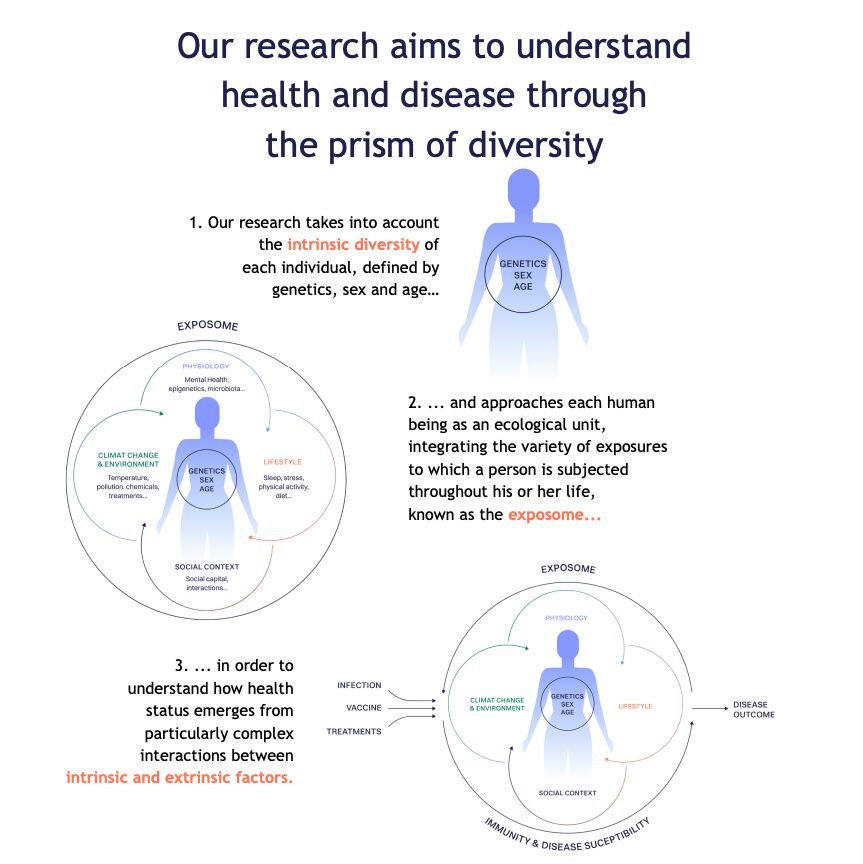
Integrating genetics, sex, and age
Exploring how genetic background, sex, and hormonal factors shape physiological responses, disease susceptibility, and outcomes.
This line of research builds on the LabEx Milieu Intérieur, a pioneering program led by the Institut Pasteur on the determinants of immune variability, and benefits from collaboration with Université Paris Cité’s Institut Santé des Femmes.
Results of the PA3 call Seed Grants – 2026 Edition
The scientific priority of Area 3, “Origins of Disease,” is pleased to announce the four projects selected from among the twenty-four received in response to the call for proposals “PA3 Seed Grants – 2026 edition.”
As a reminder, this internal funding program is designed to encourage young researchers at the Institut Pasteur by supporting exploratory and interdisciplinary projects aimed at answering questions related to the priority area.
List of the four selected projects:
- Integrating CRISPRi screens and in vitro microbiota model to uncover AIEC LF82 genetic factors involved in colonization and Crohn’s disease development – T. Vilela Rodrigues (Postdoc) & N. Barrabes (PhD student)
- Decoding the neural roots of thymic sexual dimorphism – V. Venzin (Postdoc) & A. Blondeau (PhD student)
- Metabolic Disorders and Infectious Disease Risk: Assessing Epidemiological and Mechanistic Evidence in South America – JJ. Rosado Sandoval (Postdoc) & M. André (Postdoc)
- Cycling Towards Identity: MODEling the Fate Engine in Pluripotent Cells – G. Burnet (Postdoc) & N. Quiblier (Postdoc)